Tap Drill Size Calculator
Pick the thread, set the percent of thread you want, and get the nearest standard drill in number, letter, fraction, or metric sizes. Covers UNC, UNF, and metric coarse and fine taps.
How The Tap Drill Size Is Calculated.
The tap drill diameter is the major diameter of the thread minus the height of thread you want to cut. For inch threads, pitch is 1 ÷ TPI. For metric, pitch is the number after the ×. Example: 1/4-20 at 75% is 0.250 − (0.013 × 75 ÷ 20) = 0.2013 in, and the closest standard drill is #7 at 0.201 in.
Charts assume 75% of thread because that is the trade between thread strength and tap life. Above 75% the strength gain is small and tap torque climbs fast, which is where broken taps come from. Below about 60% the thread starts to lose measurable holding strength, though in hard materials that trade is often worth it.
Tap Drill Chart, 75% Thread
UNC
| Thread | Tap Drill | in | mm |
|---|---|---|---|
| #1-64 | #53 | 0.0595 | 1.51 |
| #2-56 | #50 | 0.0700 | 1.78 |
| #3-48 | #47 | 0.0785 | 1.99 |
| #4-40 | #43 | 0.0890 | 2.26 |
| #5-40 | #38 | 0.1015 | 2.58 |
| #6-32 | #36 | 0.1065 | 2.71 |
| #8-32 | #29 | 0.1360 | 3.45 |
| #10-24 | #25 | 0.1495 | 3.80 |
| #12-24 | #16 | 0.1770 | 4.50 |
| 1/4-20 | #7 | 0.2010 | 5.11 |
| 5/16-18 | F | 0.2570 | 6.53 |
| 3/8-16 | 5/16 | 0.3125 | 7.94 |
| 7/16-14 | U | 0.3680 | 9.35 |
| 1/2-13 | 27/64 | 0.4219 | 10.72 |
| 9/16-12 | 31/64 | 0.4844 | 12.30 |
| 5/8-11 | 17/32 | 0.5312 | 13.49 |
| 3/4-10 | 21/32 | 0.6562 | 16.67 |
| 7/8-9 | 49/64 | 0.7656 | 19.45 |
| 1-8 | 7/8 | 0.8750 | 22.22 |
UNF
| Thread | Tap Drill | in | mm |
|---|---|---|---|
| #0-80 | 3/64 | 0.0469 | 1.19 |
| #1-72 | #53 | 0.0595 | 1.51 |
| #2-64 | #50 | 0.0700 | 1.78 |
| #3-56 | #45 | 0.0820 | 2.08 |
| #4-48 | #42 | 0.0935 | 2.37 |
| #5-44 | #37 | 0.1040 | 2.64 |
| #6-40 | #33 | 0.1130 | 2.87 |
| #8-36 | #29 | 0.1360 | 3.45 |
| #10-32 | #21 | 0.1590 | 4.04 |
| #12-28 | #14 | 0.1820 | 4.62 |
| 1/4-28 | #3 | 0.2130 | 5.41 |
| 5/16-24 | I | 0.2720 | 6.91 |
| 3/8-24 | Q | 0.3320 | 8.43 |
| 7/16-20 | 25/64 | 0.3906 | 9.92 |
| 1/2-20 | 29/64 | 0.4531 | 11.51 |
| 9/16-18 | 33/64 | 0.5156 | 13.10 |
| 5/8-18 | 37/64 | 0.5781 | 14.68 |
| 3/4-16 | 11/16 | 0.6875 | 17.46 |
| 7/8-14 | 13/16 | 0.8125 | 20.64 |
| 1-12 | 59/64 | 0.9219 | 23.42 |
Metric Coarse
| Thread | Tap Drill | in | mm |
|---|---|---|---|
| M1.6 x 0.35 | 1.3 mm | 0.0512 | 1.30 |
| M2 x 0.4 | 1.6 mm | 0.0630 | 1.60 |
| M2.5 x 0.45 | 2.1 mm | 0.0827 | 2.10 |
| M3 x 0.5 | 2.5 mm | 0.0984 | 2.50 |
| M4 x 0.7 | 3.3 mm | 0.1299 | 3.30 |
| M5 x 0.8 | 4.2 mm | 0.1654 | 4.20 |
| M6 x 1 | 5.0 mm | 0.1969 | 5.00 |
| M8 x 1.25 | 6.8 mm | 0.2677 | 6.80 |
| M10 x 1.5 | 8.5 mm | 0.3346 | 8.50 |
| M12 x 1.75 | 10.3 mm | 0.4055 | 10.30 |
| M14 x 2 | 12.1 mm | 0.4764 | 12.10 |
| M16 x 2 | 14.0 mm | 0.5512 | 14.00 |
| M18 x 2.5 | 15.5 mm | 0.6102 | 15.50 |
| M20 x 2.5 | 17.5 mm | 0.6890 | 17.50 |
| M24 x 3 | 21.0 mm | 0.8268 | 21.00 |
Metric Fine
| Thread | Tap Drill | in | mm |
|---|---|---|---|
| M8 x 1 | 7.0 mm | 0.2756 | 7.00 |
| M10 x 1 | 9.0 mm | 0.3543 | 9.00 |
| M10 x 1.25 | 8.8 mm | 0.3465 | 8.80 |
| M12 x 1.25 | 10.8 mm | 0.4252 | 10.80 |
| M12 x 1.5 | 10.5 mm | 0.4134 | 10.50 |
| M14 x 1.5 | 12.5 mm | 0.4921 | 12.50 |
| M16 x 1.5 | 14.5 mm | 0.5709 | 14.50 |
| M18 x 1.5 | 16.5 mm | 0.6496 | 16.50 |
| M20 x 1.5 | 18.5 mm | 0.7283 | 18.50 |
| M24 x 2 | 22.0 mm | 0.8661 | 22.00 |
Inch drills are the closest number, letter, or fractional size. Metric drills are the closest 0.1 mm size (0.5 mm above 13 mm).
FAQs
What size drill do I use for a 1/4-20 tap?
A #7 drill (0.201 in) for 75% thread. A 13/64 drill (0.203 in) gives about 72% and works in most steel.
What size drill do I use for an M6 tap?
5.0 mm for 77% thread. A #8 drill (0.199 in, 5.05 mm) is the closest inch drill and gives about 73%.
What size drill do I use for a 3/8-16 tap?
A 5/16 drill (0.3125 in) for 77% thread. An O drill (0.316 in) gives about 73%.
What size drill do I use for an M8 x 1.25 tap?
6.8 mm for 74% thread. A 17/64 drill (0.2656 in, 6.75 mm) gives 77%.
What percent of thread should I use?
75% is the default and matches every published chart. Drop to 55 to 65% in stainless, tool steel, and titanium, where tap breakage is the main risk. Go to 75 to 85% in aluminum, brass, and plastics, where the material is weak and you need more thread engagement to hold.
Why does this calculator give a different drill than my chart?
Charts fix the percent of thread at 75% and round to one drill. This calculator lets you change the percent and shows the actual thread you get from the drill you have, so a 70% or 80% result is expected once you move the slider or switch drill sets.
Can I use a metric drill for an inch tap?
Yes. The tap does not care what the drill is called. Switch the drill set to metric and the calculator shows the closest millimeter drill and the thread percent it produces.
How do I know what thread I have?
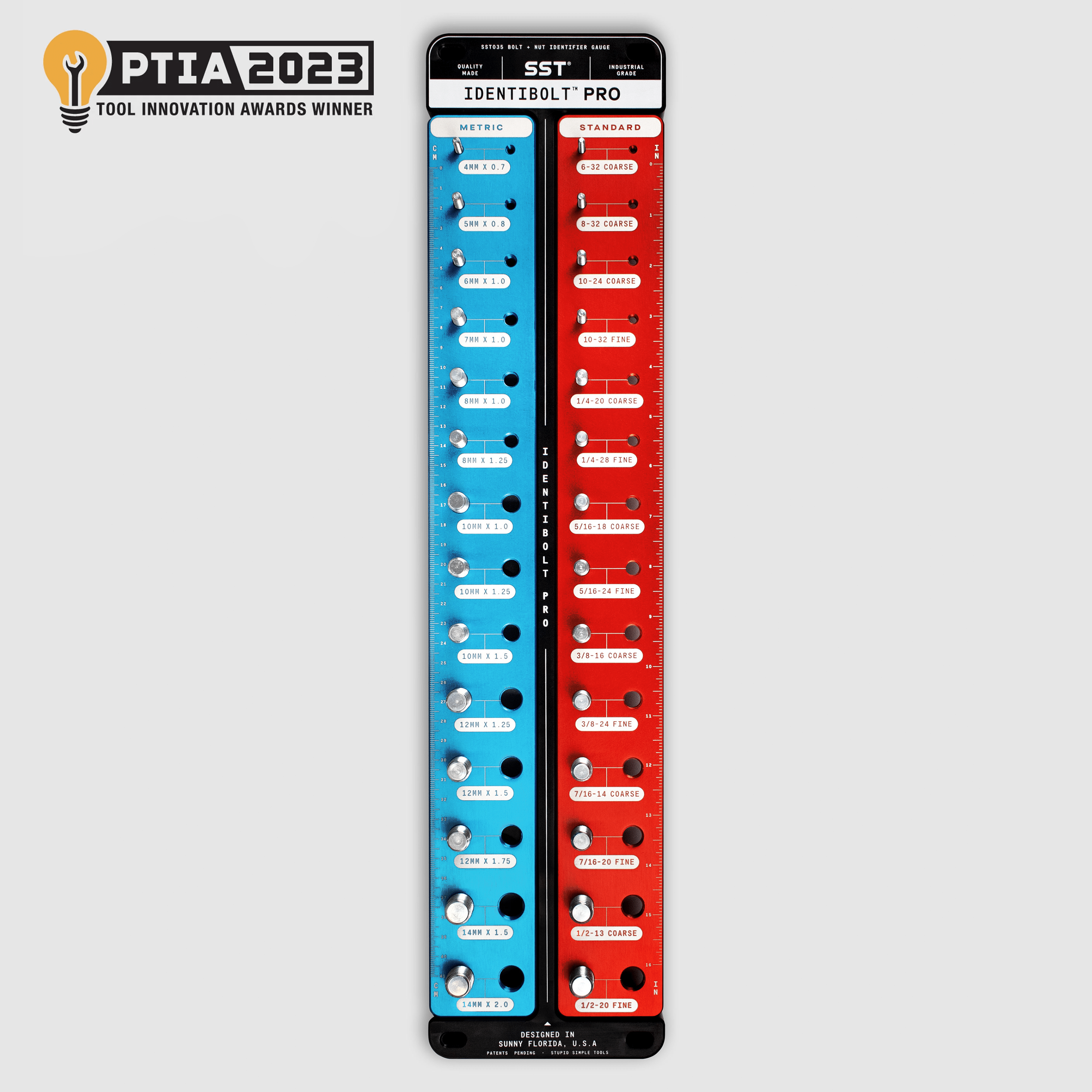
Measure the major diameter with calipers and count threads per inch, or measure the pitch in millimeters, then match it to the size list above. If you check fasteners often, an Identibolt does this in one step with no measuring.